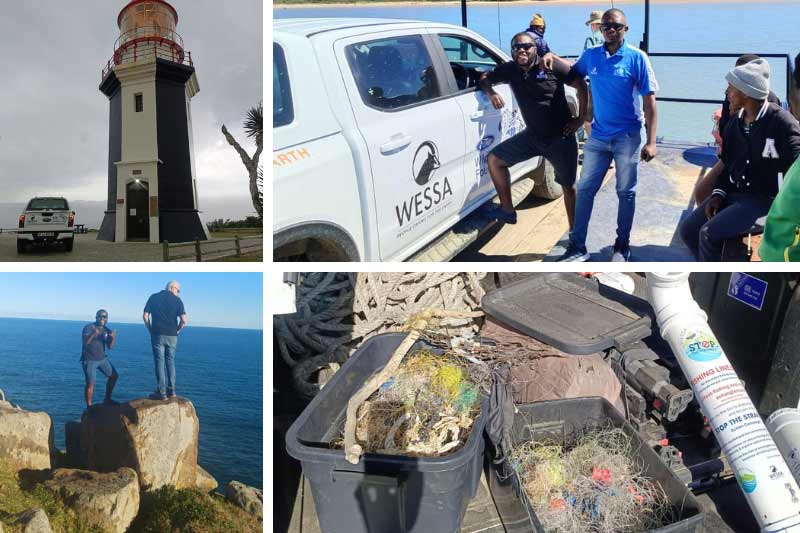
Pictured above: (Top left) Fish River Lighthouse captured on our fieldwork travels; (top right) Kei River Pont, a WESSA Green Coast site feat. The Ford Ranger (bottom right) ‘Stop the Strangle’ addressing marine pollution with the roll out of the Ford 100 Relay in which 100 new sites for collection and data analysis will be created (bottom left) Cliffs at Morgan Bay, a Green Coast site.
As summer approached, WESSA’s Coastal Programme stepped into a month filled with action, collaboration, and national visibility. Whether raising awareness about ghost gear through a new documentary, guiding municipal decision-makers, or contributing to national coastal and tourism strategy platforms, the team continued to champion the protection of South Africa’s coastline.
Each initiative reflects our commitment to enabling communities, strengthening governance, and safeguarding the ecosystems that sustain us.
Spotlighting the fight against ghost gear – an upcoming documentary on ‘Stop the Strangle’ thanks to the Ford Wildlife Foundation
WESSA hosted the Ford Wildlife Foundation and their marketing and production team to film a documentary on our ‘Stop the Strangle’ coastal action campaign. This forms part of the national Ford 100 Relay, which will publicly spotlight WESSA’s initiative to roll out 100 fishing-line collection and monitoring bins across South Africa.
This activation highlights the challenges of marine pollution with a spotlight on ghost gear and ghost fishing where 640,000 tonnes of fishing gear are lost annually, contributing to the deaths of 100,000 marine mammals and over one million seabirds each year. The filmed feature will showcase the national placement of our branded collection and analysis bins and explain how coastal communities are tacking the issue of ghost fishing by contributing as citizen scientists in ‘Stop the Strangle.’
Strengthening coastal compliance and management
The WESSA Coastal Programme presented to the City of Cape Town Permit Advisory Forum, where we provided expert input on coastal management considerations linked to beach operations, tourism activities, and environmental compliance. Our contribution emphasised Blue Flag standards, marine pollution risks, and opportunities to strengthen coastal stewardship.
Sharing WESSA’s model for community-led coastal protection at the ICM Lekgotla, East London
The team participated in the ICM Lekgotla held in East London, delivering a presentation that showcased WESSA’s role in strengthening national coastal governance. We highlighted progress across Blue Flag, Green Coast, and community-driven coastal conservation initiatives, while contributing to discussions on integrated coastal planning, improved stakeholder coordination, and alignment with national policies.
Contributing to coastal conservation and tourism strategic drivers
WESSA has continued to play an active role in shaping national coastal and tourism strategies. Over the past month, the Coastal Programme has participated in:
- Coastal committee meetings focused on coastal management, pollution mitigation, and user-conflict resolution.
- The Operation Phakisa Tourism Skills Expert Group, where WESSA contributed insights on coastal tourism workforce development, inclusive coastal access, and skills pathways that support sustainable coastal economies.
These engagements continue to position WESSA as a leading contributor to the national coastal and tourism agenda.