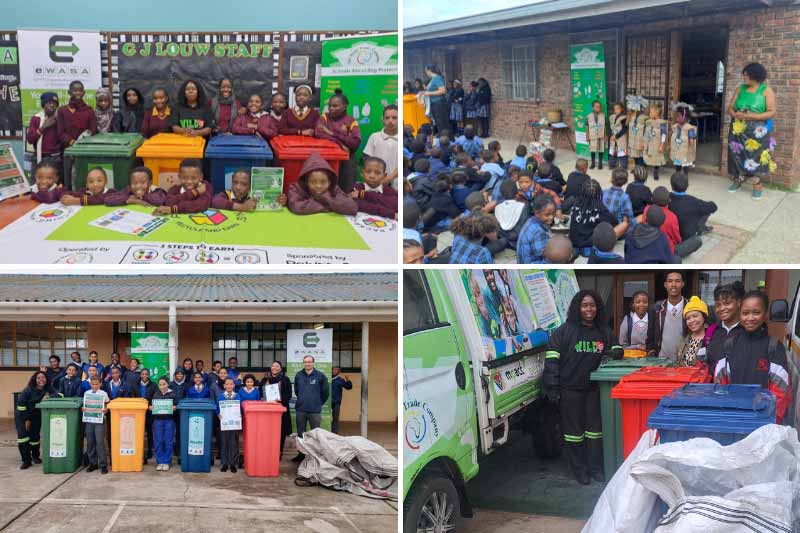
Pictured above: Top left – Launching the recycling programme at GJ Louw Primary School; (top right) Kuyga Primary School learners presenting Trashion creations; (bottom right) Hillside Technical School receiving their recycling bins and bulk bags; (bottom left) Abraham Levy Primary School Eco-committee with their recycling bins & bulk bags
What happens when learners are encouraged to see waste differently?
Across 10 schools in Nelson Mandela Bay, learners and teachers are beginning to explore the answer: waste can be separated, recycled and even transformed into something new.
From 18–21 May 2026, WESSA and eWASA launched school recycling programmes at these Eastern Cape schools:
- Kuyga Primary School
- David Livingstone High School
- Westview Special School
- Hillside Technical School
- GJ Louw Primary School
- Abraham Levy Primary School
- Chapman High School
- Happydale Special School
- St Thomas Senior Secondary School
- Paterson High School
Learning how recycling begins
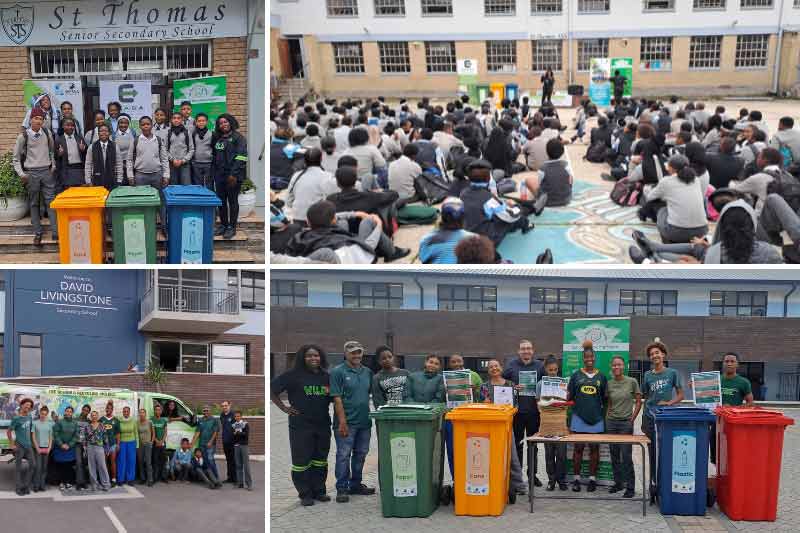
Pictured above: (top left & right) St Thomas Senior Secondary School with their recycling bins & engaging in a recycling presentation during assembly; (bottom left & right) David Livingstone learners with The Waste Trade Company team & launching their schools recycling programme
The sessions introduced learners and teachers to the recycling process through practical separation-at-source activities. Participants learnt how to correctly separate and sort waste, building the knowledge needed to support more responsible waste management practices at their schools.
Each school received four recycling bins and three bulk bags to help establish its recycling programme.
The Waste Trade Company joined the sessions to explain which materials can and cannot be recycled and how the collection process will work at each school.
Reimagining the value of waste
The Eastern Cape launch also encouraged learners to think creatively about materials that might otherwise be discarded.
During the sessions, The Waste Trade Company showcased upcycled items, including clothing, fashion accessories and toys made from waste materials. These examples helped learners see that waste is not only an environmental challenge; it can also be an opportunity for creativity and innovation.
This message was reinforced through the launch of the Trashion Design Challenge, which invites learners to create fashion pieces using recycled waste.
Growing practical environmental action
The school recycling programmes are designed to improve awareness of responsible waste management while giving schools the infrastructure needed to put this knowledge into practice.
By combining education, recycling systems and creative upcycling, the project is helping learners understand that their everyday choices matter. A plastic item, container or piece of discarded material does not always need to become waste. With the right knowledge and systems in place, it can become part of a more sustainable future.