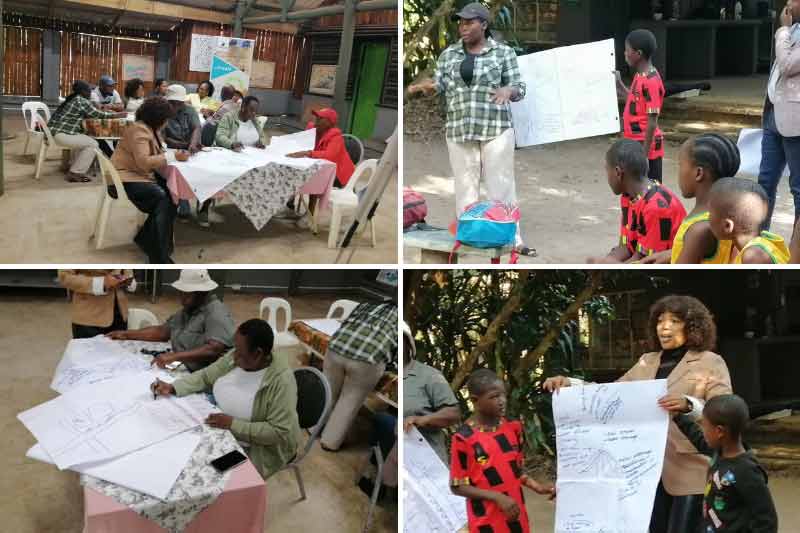
Pictured above: Nxenjane Primary School, attending the WESSA Twinstreams Education Centure
This April, WESSA’s Education Centres continued to create meaningful learning spaces where learners could explore environmental challenges through curiosity, creativity and practical problem-solving.
From the WESSA Twinstreams Education Centre to the WESSA uMngeni Valley Education Centre, learners were introduced to hands-on activities that connected classroom knowledge with real-world environmental action.
Turning environmental challenges into solutions
At the WESSA Twinstreams Education Centre, Nxenjane Primary School participated in the Old Mutual Insurance project, which empowers educators and learners to identify environmental issues in their schools and communities and develop practical solutions through innovation.
The project integrates environmental learning into e-STEAM subjects: Environment, Science, Technology, Engineering, Arts and Mathematics. Through this approach, learners are encouraged to think critically, explore sustainability-focused solutions, and apply their classroom knowledge in practical ways.
Using the “Solution Flower” framework, learners unpacked environmental issues from the ground up, developing ideas that could be shaped into prototypes and real-world interventions.
First-time learning experience at uMngeni Valley
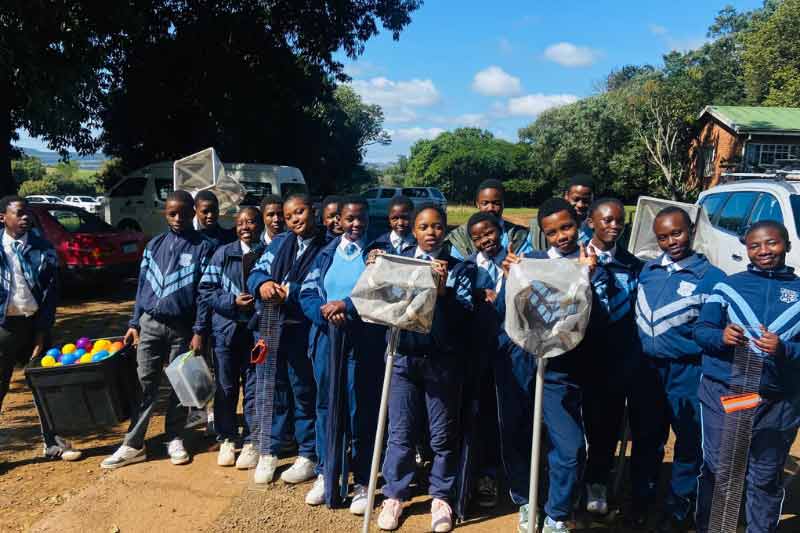
Pictured above: Asithuthuke Combined School learners exploring previous projects and prototypes at the WESSA uMngeni Valley Education Centre.
Asithuthuke Combined School from Zenzani Village in Howick visited the WESSA uMngeni Valley Education Centre for the first time in April. Learners took part in introductory activities focused on water quality studies and team building, giving them an opportunity to strengthen their connection with both their educators and peers.
During their visit, learners explored the Science Centre, also known as the e-STEAM Room, where they viewed previous projects and prototypes created by other schools. These examples offered inspiration and showed learners how environmental challenges can be turned into practical, creative solutions.
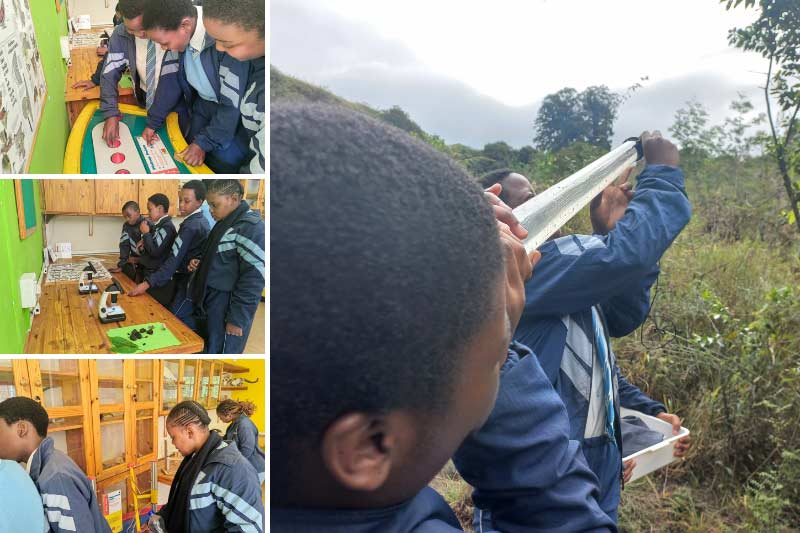
Pictured above: Asithuthuke Combined School learners taking part in the Pickup Points challenge, exploring how sound travels through a bucket radio experiment, and conducting a miniSASS water quality test using a clarity tube to see the water clearance.
The learners also participated in the Pickup Points challenge, where they worked to remove corn from different holes. This activity tested their patience, problem-solving and critical thinking skills in an engaging and practical way.
Another highlight was the bucket radio sound experiment. Using a metal bucket setup, learners compared two different bucket sizes to investigate which produced the loudest sound. The activity helped learners explore how sound travels and how size and material can affect sound intensity through real-time experimentation.
WESSA’s Education Centres offer experiential learning, giving learners the space to ask questions, test ideas, work together and discover how science, creativity and environmental action can shape a more sustainable future.
Contact us to learn more and book your next Education Centre visit. https://www.wessa.org.za/education-centres/