Winners of the latest YRE competition announced

Winners of the latest YRE competition announced

Meet the incredible young winners of our latest YRE competition!
 
Article Winner
“Stop, it’s not a bin – Illegal Dumping in Danston”
by Gaorekwe Molusi, Dr EP Lehela Secondary School, Northern Cape
 
 
Photo Winner
“The regrowth after a fire on Rondebosch Common”
by Alexandra de Roo, Pinelands High School, Western Cape
 
Photo Winner
 
Video Winner
“Water Scarcity”
by Sphamandla Ngcobo, Mzuvele High School, KwaZulu-Natal
 
Video Winner
(Click the video to watch)
 
Each of these powerful entries has been entered into the national YRE competition, a celebration of youth voices speaking up for the environment.
The Westin Cape Town officially achieves Green Key certification

The Westin Cape Town officially achieves Green Key certification

We’re thrilled to announce that The Westin Cape Town has officially achieved Green Key certification, becoming the first Marriott International hotel in South Africa to receive this leading sustainability recognition.
 
This achievement reflects the hotel’s outstanding commitment to energy efficiency, water conservation, sustainable sourcing, and community engagement. Their efforts have already saved over 1.4 million litres of water and 170,000 kg of CO₂ emissions -setting a powerful example for the tourism industry.
 
Congratulations to The Westin Cape Town team and welcome to the Green Key family!
OUR CEO, Cindy-Lee Cloete graduates from Wits with distinction

OUR CEO, Cindy-Lee Cloete graduates from Wits with distinction

It is with much pride that we congratulate our CEO, Ms Cindy-Lee Cloete, on her graduation today from University of the Witwatersrand in Johannesburg. Cindy graduated top of her class with distinction as she successfully completed the Postgraduate diploma in Philanthropy and Resource Mobilisation.

Cindy is an exceptional leader who exercises the importance of continuous learning and knowledge sharing.

Well done Cindy, WESSA is proud of you!

WESSA releases mining and energy policies

WESSA releases mining and energy policies

The Board has approved two policies, developed by the Environmental Governance Committee and its contributing volunteer experts, to guide WESSA’s engagement and activism concerning current and future mining energy issues.

These policies recognise that the socio-economic and environmental landscapes are complex and so must make space for continuous change and emergence. We recognise that there needs to be some major “transitions”, particularly in how we think about mineral wealth and energy, and the impacts on jobs and livelihoods built around existing activities and systems.

Read our Position Statements.

WESSA and UNICEF unite to drive youth-led water resilience across South Africa

WESSA and UNICEF unite to drive youth-led water resilience across South Africa

As South Africa faces increasing water shortages and water quality challenges, WESSA has partnered with the United Nations Children’s Fund (UNICEF) on the Youth Leading in Water Resilience Project. Part of the Water, Sanitation, and Hygiene (WASH) programme, this initiative empowers young people in South Africa to tackle one of the nation’s most urgent challenges: water security.

Running from October 2024 to March 2025, the programme will engage 29 000 learners between the ages of 5 and 19 across 30 schools in Gauteng, the Northern Cape, KwaZulu-Natal, and the Free State. Over 4 000 unemployed youth – mainly from rural and peri-urban areas – are being trained to lead water resilience efforts. This extensive outreach is designed to create a ripple effect, deepening community engagement in tackling South Africa’s urgent water challenges.

The involvement of community members, including government officials, further amplifies its impact. By training both local leaders and government representatives, the project aims to embed sustainable water practices within the structures that oversee the country’s water systems, fostering collaboration and action across sectors to ensure that water monitoring becomes a shared responsibility.

Water monitoring
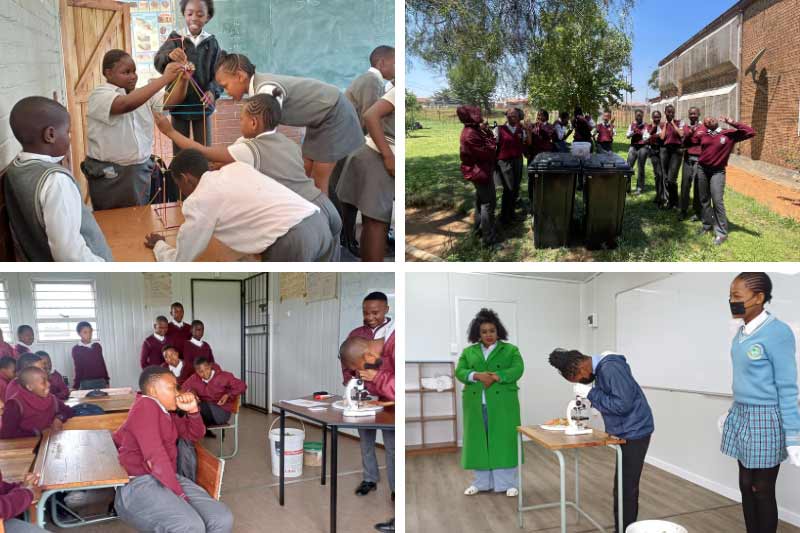
Water quality testing at Okiep Hoerskool.

Water quality testing

The initiative focuses on water quality monitoring, capacity building, and community-based solutions, aiming to build a generation of informed and empowered water custodians. Through the project, youth and community members play an integral role in community-based water monitoring, while working to ensure that clean drinking water is accessible and that water systems are maintained effectively. By encouraging a spirit of collaboration, UNICEF and WESSA aim to empower children, youth and their communities to prioritise water resilience.

“Water is the foundation of life and a resource under tremendous strain in our country. This project aims to empower children and young people by providing them with the skills, resources, and knowledge to monitor water quality in their schools and communities. Participants will gain hands-on experience in identifying and addressing water-related issues, as well as learn how to advocate for sustainable water management practices,” says Cindy-Lee Cloete, WESSA’s CEO.

These sentiments are echoed by Christine Muhigana, UNICEF South Africa Representative who notes that “empowering children and young people to take ownership of water resilience is crucial for South Africa’s future. Through this programme, we are cultivating a generation of informed and motivated water custodians who will champion sustainable water management practices and ensure a water-secure future for all.”

Water warriors

The support of WaterCAN’s data management system ensures that water quality insights are accurately stored, analysed, and leveraged to make impactful decisions. Ferrial Adams, Executive Manager at WaterCAN, emphasises the importance of the data-driven approach, adding, “by engaging children and youth through citizen science, the initiative deepens their understanding of water issues and encourages sustainable practices. This effort not only raises awareness but also empowers the next generation to take proactive steps in preserving our precious water resources and becoming water warriors.”

As the country grapples with erratic rainfall, recurring droughts and flooding, and contaminated water supplies, the need for initiatives like this has never been greater. South Africa’s fragile water resources are critical to the well-being of millions, particularly those living in under-resourced regions. Through this partnership, UNICEF and WESSA address the issue holistically bridging the gap between education, community mobilisation, and systemic reform.

water resources
Water quality testing at St Anna Private School

Vote for your favourite in the Richard Lewis Art Competition

Vote for your favourite in the Richard Lewis Art Competition

This poll has ended (since 22 days).

Six finalists have been selected by our panel of judges. The winner will be chosen by you! Please vote now by clicking the circular button next to the artwork description, and then clicking on VOTE. Please note, only one vote per person is allowed.

Voting closes 6 November 2024 and the winner will be announced on 8 November 2024.

Eli Kagen
There’s a mix of humour and concern in this photo—the monkey’s placement on the “DON’T FEED” sign feels almost playful, but it also highlights an important issue. Feeding animals, especially with unhealthy human foods, messes with their natural behavior and their health. It’s a powerful reminder that our actions, even if well-intentioned, can have negative effects on wildlife. This photo also reflects the theme of “Parts of a Whole.” The sign, the monkey, and the interaction with human food all represent parts of a bigger system—one where our actions directly impact animals and their environment. Ultimately, the photo challenges us to think about our impact on the world and how we can help restore balance by being more conscious of how our actions affect animals and the environment.
594
Adam Silbert
My work is depicting the infiltration of the alien humans who are polluting nature. You can see this through the pollution which is drawn in pen and coloured in red, whilst everything else is done in pencil.
475
Asher Friedman
The portrait is of myself and a Rock Hopper Penguin. The meaning of this portrait is to show my awareness and love for this penguin as there are slowly decreasing in population.
179
Thato Chabaesele
The artwork shows two different human settlements - informal and formal - with a river as their main source of water for both human and animals.
142
Mpho Masilo
The artwork shows the after effects of industrial factories on their immediate environment. The community river has been polluted and is negatively impacting the plant and animal life. The work is promoting not only self respect but respect for nature and the environment."
45
Errin Keymer
This artwork (which I call shattered connections) has been made with black fineliners using a stippling effect on an A3 page. The theme ‘part of a whole’ is captured through the abstract fragmented pieces. It shows how human actions can break nature, with the rose representing nature while the lines cutting through them symbolise how humans harm the environment. Even though the roses are broken, they are still visible which shows how strong and fragile nature is. This idea fits the theme because it shows how everything in nature is connected. Even when we harm the environment we are still able see the beauty in it and it reminds us to protect and restore nature before it is too late.
31