
Conservation insights from the Magaliesberg Biosphere
Vultures, Leopards and Spiritual Stewardship
In the WESSA Northern Area Region, recent expert talks explored the mounting pressures facing wildlife in South Africa’s Magaliesberg Biosphere – from poisoning and snares to land-use change and the environmental impact of cultural practices.
Contributions from John Wesson, Dr John Ledger, Dr Leanne Venter and Dr Cathy Dzerefos underscored a common theme: conservation in human-dominated landscapes demands data-driven action, strong partnerships and cultural sensitivity.
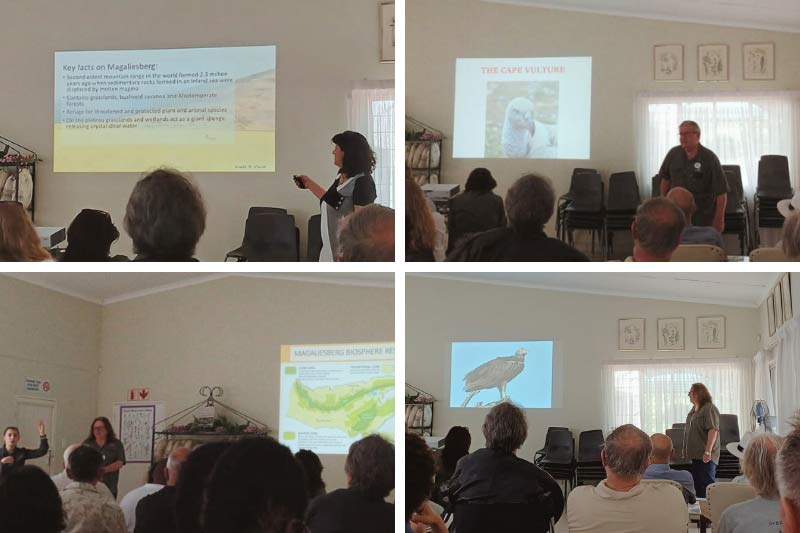
Pictured above: Presenters Dr Cathy Dzerefos, Dr John Ledger, Dr Leanne Venter and John Wesson
Vulture decline: old world giants under siege
John Wesson outlined the status of vulture species in South Africa, distinguishing between “old age” vultures —mostly African, open-country dwellers— and “new age” vultures found in the Americas and dense forests.
Particular focus was placed on Cape vultures, now classified as endangered due to multiple threats. Lappet-faced vultures hold the title for the largest wingspan, while white-backed vultures — though abundant in Kruger National Park — are critically endangered, with only 40,000–50,000 individuals remaining.
Poisoning has driven sharp declines in vulture populations, compounded by elephants disrupting nesting trees.
Dr John Ledger expanded on the status of Cape vultures in the Magaliesberg, tracing the historical relationship between humans and vultures, including the role of social and traditional beliefs. Events such as the Anglo-Boer Wars accelerated population crashes.
Today, vultures face a complex web of threats: shooting, poisoning, land-use change, food shortages, powerlines, wind turbines and veterinary drugs. The message was clear: urgent mitigation is needed.
Apex predators in a snare-riddled landscape
Dr Leanne Venter provided an update on Magaliesberg’s leopard population. Leopards are highly adaptable apex predators that roam widely outside protected areas. However, survival rates drop significantly in human-dominated landscapes compared to those inside reserves.
Accidental snaring for bushmeat remains a leading cause of leopard mortality. Snares also alter leopard behaviour, as animals are drawn to scavenge trapped prey at snare sites.
To counter this, Dr Venter’s team focuses on snare removal, making poaching less viable. Fewer wires in the landscape increase costs and effort for criminals. Between 2017 and 2021, snare numbers dropped across six monitored sites.
Current efforts include:
- Developing predictive models to identify snare hotspots
- Strengthening landowner and conservation partnerships
- Raising community awareness
- Launching a new 2026–2027 citizen science project to bolster leopard conservation
As apex predators, leopards play a vital role in maintaining ecosystem balance. The Magaliesberg remains an important refuge within an increasingly human-dominated landscape. Long-term survival will depend on curbing snares, building strong collaborations and implementing evidence-based strategies.
Spiritual healing meets environmental stewardship
Dr Cathy Dzerefos explored the intersection of African spiritual practices and environmental stewardship in the Magaliesberg.
Healing ceremonies, while culturally significant, can impact rivers through candle wax and waste that are often left behind. In one instance, an unattended candle led to a fire that destroyed a nature reserve.
Working alongside traditional healer Dr Mabena from Mamelodi who shares environmental concerns, Dr Dzerefos highlighted opportunities for collaboration rather than conflict.
At Majankaneng forest, which contains multiple streams accessible to local communities, painted signage now discourages littering after ceremonies. These initiatives are encouraging healers and communities to become environmental stewards, demonstrating how cultural practices can align with conservation goals.
A Call for Holistic Conservation
Together, these expert insights reflect the interconnected threats facing the Magaliesberg Biosphere: habitat loss, human-wildlife conflict and cultural impacts all require integrated responses.
By combining science, partnerships and cultural sensitivity, conservation efforts in the Magaliesberg can move beyond crisis response towards long-term resilience.
Safeguarding biodiversity in this landscape will depend not only on enforcement and mitigation, but on shared responsibility across communities, landowners, conservationists and cultural leaders alike.
Thank you WESSA volunteers for your impact in protecting our biodiversity and natural heritage!