
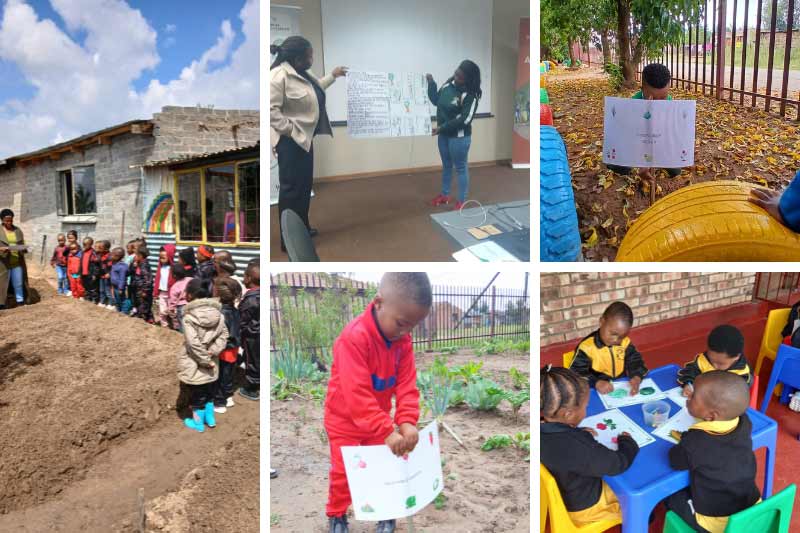
Pictured above: left – Thuto Ke Lesedi Educare Centre learners in their garden; top middle – Teachers shared their innovative ideas of how they will use their gardens for teaching; right top – Qalabotjha Creche learner marking a spot for their biodiversity garden; bottom middle – Learner at Zenzeleni Educare Centre during the garden walk; Learners colouring various food items they will plant in their garden
From 23 to 25 March 2026, WESSA launched its first implementation sessions with N3TC schools in Villiers, Free State – marking a strong step forward in embedding biodiversity and outdoor learning into school environments.
Equipping educators for outdoor learning
The visit began with a dynamic teachers’ workshop centred on this year’s focus: biodiversity and outdoor learning.
The workshop aimed to equip educators with practical knowledge and tools to transform biodiversity gardens into living classrooms that support experiential learning. Key discussions explored the critical link between biodiversity, climate resilience, and water conservation – highlighting the role schools can play in building environmentally responsible communities.
A standout moment was the collaborative design session, where teachers developed tailored plans for their own school biodiversity gardens. Educators shared innovative ideas on how these spaces will be integrated into teaching and learning, demonstrating a strong commitment to hands-on, nature-based education.
From classroom to living ecosystem
Following the workshop, the programme continued with two days of engaging learner sessions, bringing biodiversity concepts to life in practical and relatable ways.
Learners were introduced to the importance of biodiversity and its role in supporting healthy ecosystems and resilient communities, laying the foundation for deeper environmental understanding.
A key highlight was the interactive garden walk, where learners explored their school environment and guided by their teachers, participated in designing their own biodiversity gardens. This hands-on approach deepened their understanding while fostering a sense of ownership and responsibility towards their natural surroundings.
Strengthening the link between knowledge and action
Together, these sessions strengthened the connection between knowledge and action, enabling both teachers and learners to actively contribute to sustainable, biodiversity-rich school environments.
Through initiatives like this, WESSA continues to advance its mission to Educate, Advocate, Act, enabling schools to become spaces where environmental awareness is not only taught, but lived.